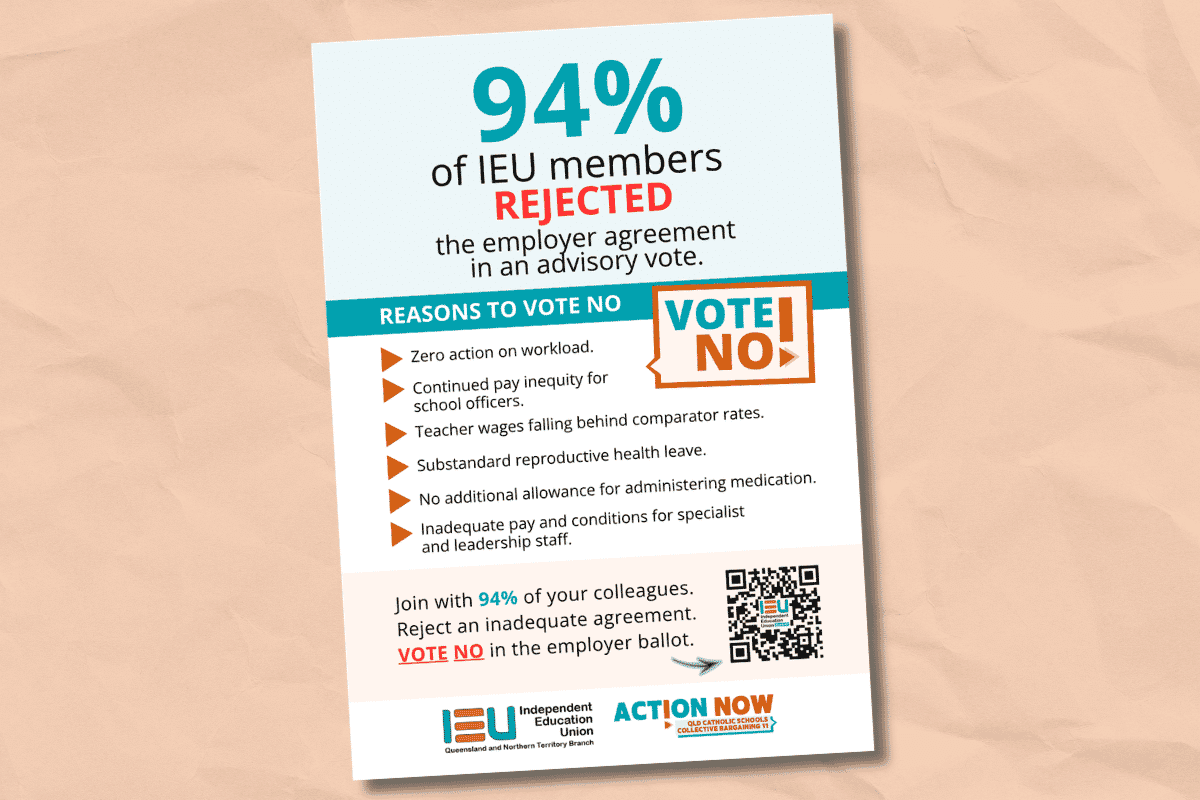
94% of IEU members rejected Queensland Catholic school employers’ agreement in an advisory vote.
Now all employees have an opportunity to VOTE NO to the inadequate employer agreement.
Voting in the employer ballot is open 19–29 October 2026.
Make your vote count. VOTE NO.
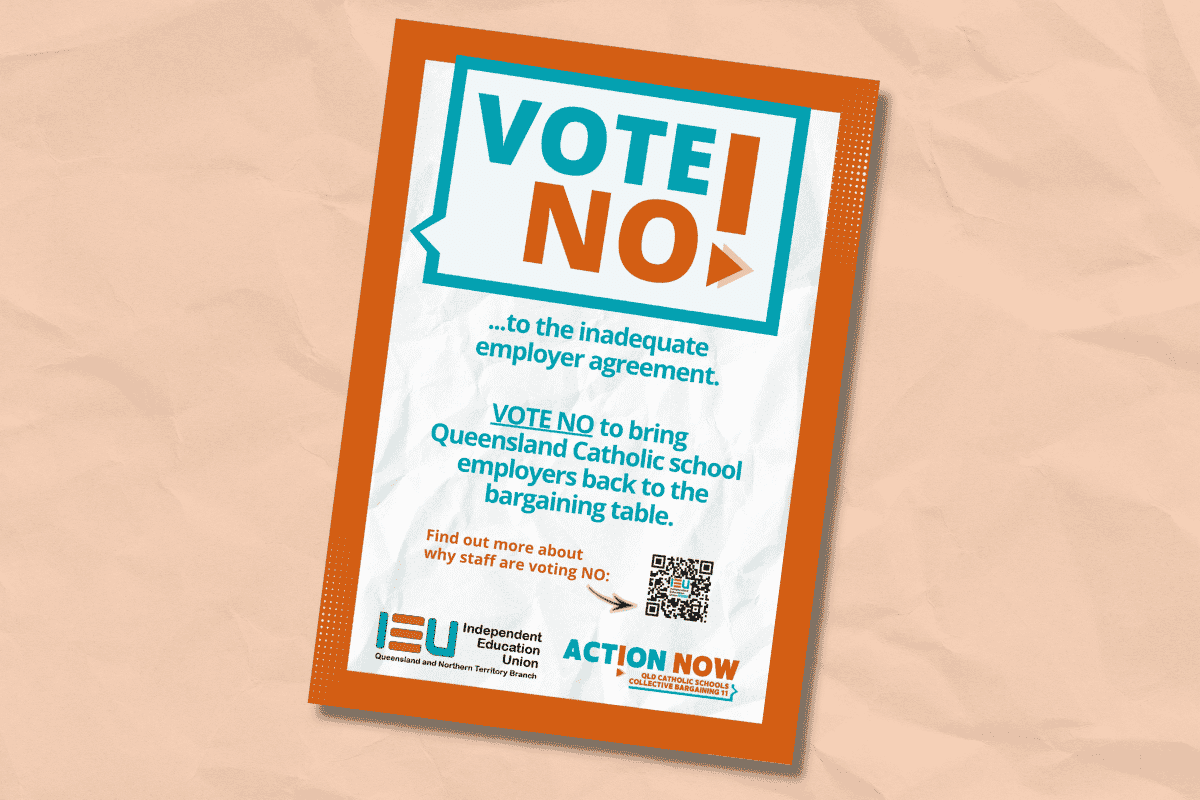
VOTE NO and bring employers back to the bargaining table.
The employer agreement is totally inadequate:
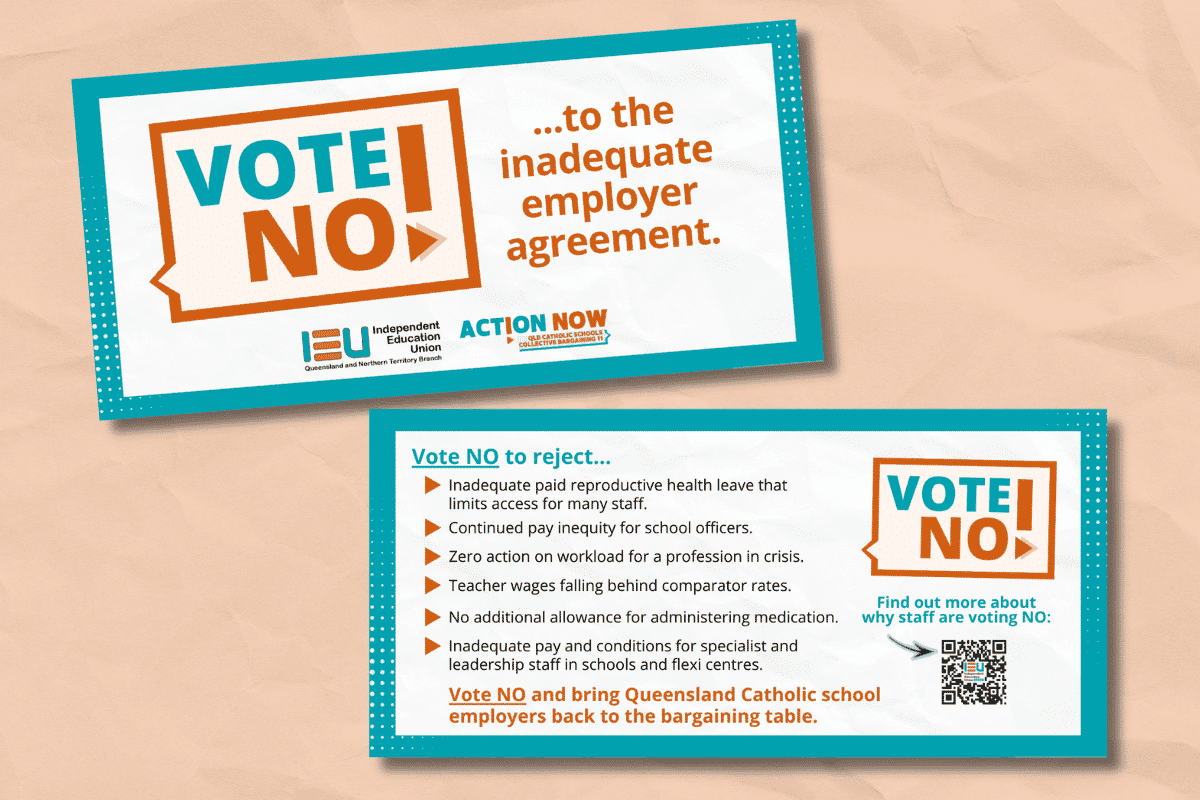
❌ Zero action on workload.
❌ Continued 10–25% pay inequity for school officers.
❌ Teacher wages fall behind New South Wales and Victorian rates.
❌ Substandard reproductive health leave.
❌ No additional allowance for administering medication.
❌ Inadequate pay and conditions for specialist and leadership staff.
Why employees are VOTING NO:
What members are saying about the employer agreement
Does not address the core issue: school officers remain 10–25% behind NSW Catholic school rates.
It is unreasonable to ignore current workload demands on teachers. We are continuing to lose great staff who simply cannot maintain an adequate work-life balance.
No attempt to even address employee claims during negotiations.
The offer does not adequately reflect the critical role of school officers or the level of commitment required in our work.
This ‘offer’ is completely out of touch.
Fails to acknowledge escalating workloads and cost of living pressures.
They can do better.
Employers are out of touch with the realities of teaching in modern classrooms.
We will continue to lose employees with a passion for education if this offer remains as is.
Shocked that my employer does not want to allow me the same reproductive health leave that public sector teachers get.
Not good enough.
Employees have a plan for ACTION NOW

WORKLOAD
Real action to address a profession in crisis.

RIGHTS
Ensure working rights meet sector standards.

WAGES
Recognise and value staff.

RECOGNITION
Value specialist and leadership roles fairly.
WORKLOAD
Employers have proposed an agreement with zero action to address workload.
There are more than 6,000 words in the employers’ detailed summary promoting their agreement, but the word “workload” does not appear even once.
And even worse, their proposed changes to the hours of duty schedule expect teachers to work even harder.
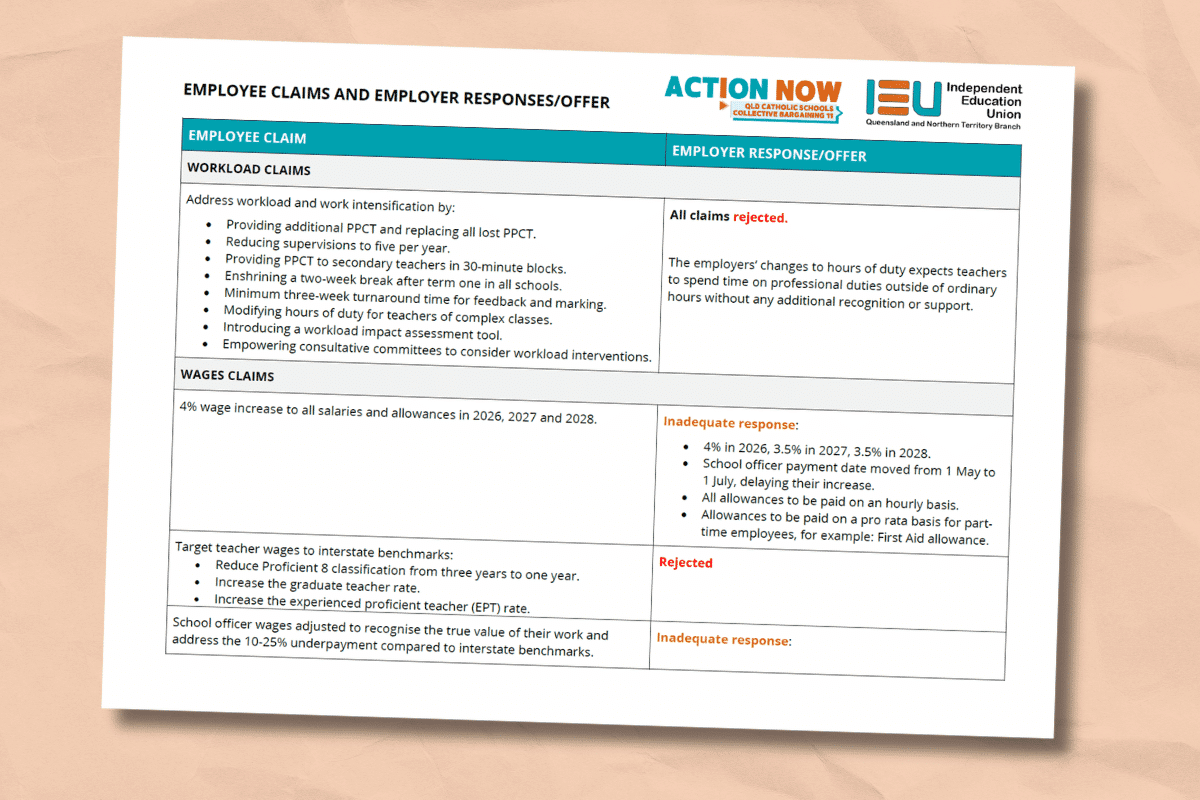
Their revised hours of duty schedule expects that teachers ‘spend time on their professional duties’ outside of the 30.5 ordinary hours without any additional support or recognition.
In contrast, employees have a plan to address workload and work intensification.
Employee workload claims would provide additional PPCT, protect existing PPCT, reduce supervisions, enshrine a two-week break after term one in all schools and set a three-week turnaround for feedback and marking.
Many employee claims have low or no-cost implications, yet employers have rejected all except one that applies in some primary schools.
It’s clear that employers want to ignore workload issues in schools.
The only way to secure action on workload is to VOTE NO.
WAGES
The inadequate employer agreement will see teacher wages fall behind significantly and will not address the 10-25% pay inequity facing school officers.
School officers:
Employees want to see school officer pay inequity addressed. Employees tabled a claim for a yearly structural adjustment to school officer wages (in addition to the regular wage increase) over the life of the agreement.
A significant adjustment to school officer wages is necessary due to the scale of the pay inequity they face. For example, classroom assistants in Queensland Catholic schools are paid between 10–25% less than those in New South Wales Catholic schools doing the same jobs.
The employer agreement contains a minor adjustment to the classification scale through the introduction of new steps at levels 2, 4 and 5 for school officers and levels 2 and 4 for services staff. The employer offer also includes a one-off 1.5% increase for employees on the highest level 3 increment.
Delaying school officer wage increases from May to July is a cruel move that will cost school officers approximately $500.
The employer agreement is not good enough and will continue to entrench unfair pay rates for school officers.
Teachers:
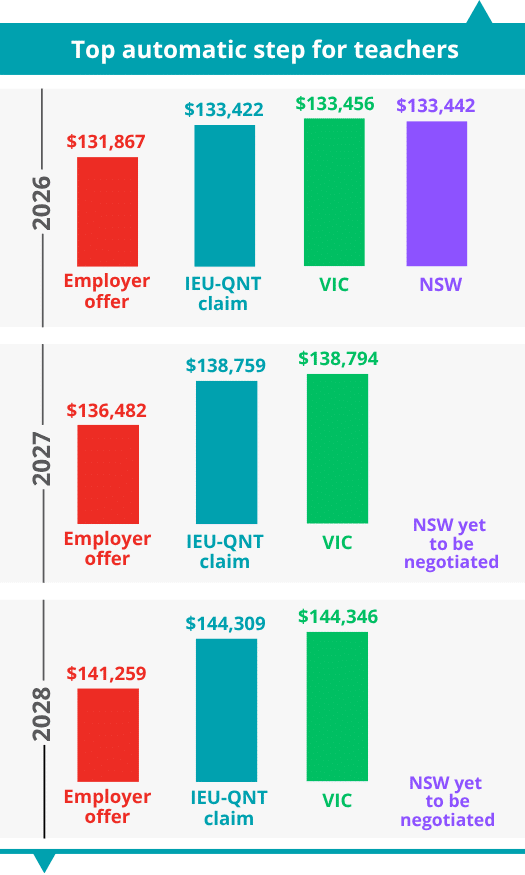
Under the employer agreement, teachers in Queensland Catholic schools would be worse off compared to New South Wales Catholic schools and Victorian schools.
Employers have proposed wage increases of:
4% in 2026
3.5% in 2027
3.5% in 2028
Without a structural adjustment to the pay spine, these increases are not good enough to get close to rates paid in NSW and VIC.
The employee claim would reach rates comparable to NSW and VIC by:
- Applying a 4% increase each year.
- Reducing the Proficient 8 classification period to one year (currently three years).
- Increasing the graduate teacher rate.
- Increasing the experienced proficient teacher (EPT) rate.
The only way to secure fair wages for all employees is to VOTE NO.
RIGHTS
Employees in Queensland Catholic schools deserve contemporary rights at work.
Paid reproductive health leave (RHL) has emerged as a benchmark working right in the education sector.
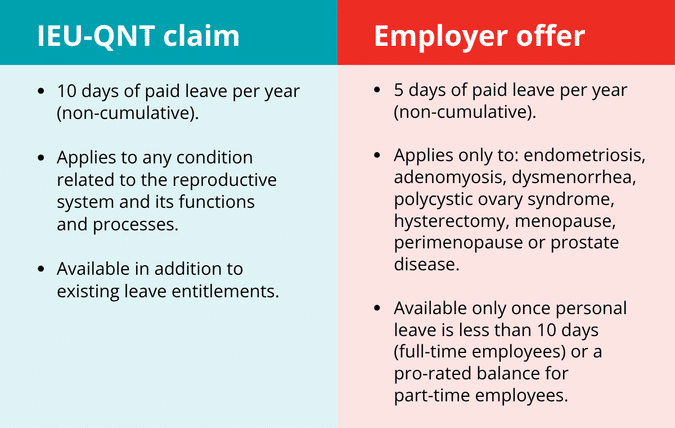
Since 2024, employees in Queensland public schools have had access to 10 days of paid reproductive health leave.
Employees are seeking an RHL entitlement comparable to the public sector.
The employer agreement falls well short on RHL.
Unless staff have a chronic specified condition and a low personal leave balance, they won’t have any access to RHL under the employer agreement.
The only way to improve substandard reproductive health leave is to VOTE NO.
RECOGNITION
Many specialist and leadership roles are not appropriately paid or resourced in schools.
Employees tabled claims to improve wages and working conditions for: Senior leaders, Teachers of inclusive student support, Primary program leaders (however named), Instrumental music teachers and tutors, Library staff, Counsellors, Staff working in flexible learning centres and special assistance schools.
Employers rejected all of these claims.
The inadequate employer agreement means:
❌ No enhanced conditions for senior leaders.
❌ No recognition of primary program leaders (however named).
❌ No additional support for library staff.
❌ No additional support for counsellors.
❌ No additional support for instrumental music teachers and tutors.
❌ No additional support for teachers of inclusive student support.
❌ Inadequate support for staff in flexi centres and special assistance schools.
The only way to ensure recognition of specialist and leadership staff is to VOTE NO to the inadequate employer agreement.
Resources
Frequently asked questions
Why is a ballot being held?
Employers have decided to hold a ballot on their inadequate agreement.
There is no in-principle agreement with IEU to hold this ballot.
Employers have effectively walked away from negotiations, despite the majority of employee claims remaining unresolved.
What is the ballot process?
The access period will start on 8 October. At this time, employers will distribute information about the proposed agreement to all employees.
Voting will open on 19 October and conclude on 29 October. Employers will distribute an electronic voting link to all employees who are eligible to participate in the ballot.
Who is eligible to vote?
All employees who will be covered by the proposed agreement are eligible to vote.
Will my employer know how I vote?
No. The online ballot is anonymous. Employers will receive only aggregate data related to the vote outcome.
How is the ballot outcome determined?
The ballot result is calculated from the number of employees who participate and cast a valid vote. A majority means more than half of all valid votes cast.
For example, if a Diocese has 1,000 eligible staff and 600 cast a vote, at least 301 “NO” votes are required to reject the proposed agreement.
Why should employees VOTE NO?
94% of IEU members rejected the proposed agreement in an advisory vote.
The ballot is an opportunity for all employees to formally reject an agreement that’s inadequate on workload, wages and conditions.
The proposed agreement contains zero workload initiatives and will mean wages for all employees fall behind national comparators.
Key employee claims remain unresolved under the proposed agreement.
If a majority of staff VOTE NO, the immediate step for employers is to return to the bargaining table.
What does VOTING NO mean for backpay?
Employers have threatened to deny backpay if staff do not vote to accept their inadequate agreement.
Rather than allowing employees to consider an agreement on its merits, employers are hoping this threat will be enough to pressure staff to accept an agreement that leaves them worse off in the long run.
This is a shameful attempt to conclude negotiations without addressing key employee claims.
It’s important to note that the employee agreement already denies approximately $500 in backpay to school officers by unilaterally moving their wage increase from 1 May to 1 July to align with the wage increase date for teachers. This move delivers a pay cut to some of the lowest-paid staff in schools, simply for payroll convenience.
The only way to respond to these tactics is to VOTE NO and bring employers back to the bargaining table where backpay will be an ongoing point of negotiation for employee representatives.
How does the arbitration in the state sector affect our negotiations?
Recent employer communications seem designed to create confusion about the public sector arbitration – showing little understanding of industrial structures.
Employers have highlighted delays in the ongoing arbitration of negotiations between the Queensland Department of Education and Queensland Teachers’ Union.
Employers know very well that the public sector negotiations take place in the state jurisdiction, while our negotiations are covered by the federal jurisdiction.
Our negotiations cannot be arbitrated by the Queensland Industrial Relations Commission and therefore cannot be subject to the same processes as the public sector negotiations.
The Fair Work Commission presides over matters in the federal jurisdiction.
With a resolution from the public sector arbitration not expected until 2027 at the earliest, national benchmarks must be considered to determine fair rates of pay in Queensland Catholic schools.
We’ve faced this situation before.
In our union’s 2016 Recognise, Respect, Reward campaign (with public sector pay rates unknown), we secured state-leading wage increases by targeting rates in New South Wales Catholic schools.
Once again, our union has an opportunity to lead the way on pay.
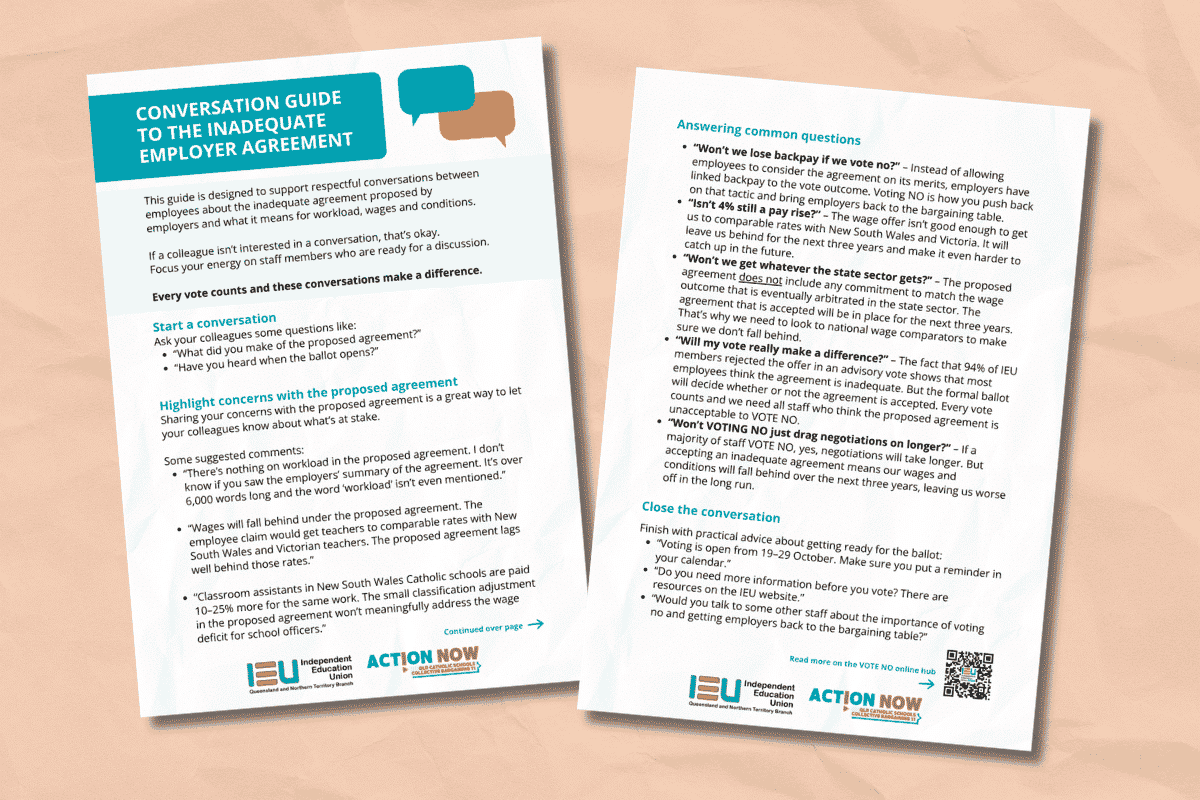
Can I talk to my colleagues about VOTING NO?
Yes. The proposed agreement impacts employees’ working conditions for the next three years.
Respectful conversations about the inadequacy of the proposed agreement are very important.
All staff should understand what the agreement means for their workload, wages and conditions.
Download our Conversation Guide to the Employers’ Inadequate Agreement for advice on speaking to your colleagues about VOTING NO.
IEU members want ACTION NOW on workload, wages and conditions











Not yet a member? Join IEU today
Every new member makes our employee voice stronger.
There is no more important time to be part of our union.
Joining means gaining all the benefits of IEU membership including support, representation and a voice at work.
Member-only resources
Member-only resources including Bargaining Loop updates and FAQs are available on the MyIEU ACTION NOW! Member Hub.