Reconciliation
Our union is committed to contributing to reconciliation.
We support two networks for First Nations members to ensure we are listening and acting in accordance with our members’ needs.
First Nations Member Networks
Our union’s Yarning Circle and Yubbah Action Group support critical engagement with First Nations members.
The Yarning Circle meets four times per year and informs our campaigning and advocacy.
Our Yubbah Action Group is a working committee within our union ensuring our commitment to reconciliation is reflected throughout our activities and is responsible for maintaining an active Reconciliation Action Plan (RAP).
The group is named after the Noonuccal word “Yubbah” meaning “message stick”, as our message stick came from Noonuccal woman and member Thersa Nunn (read more about our Message Stick below).
The group meets a minimum of five times per year.
If you’d like to know more about these First Nations member networks or register your interest in joining, please get in touch.


Reconciliation Action Plan (RAP)
Reconciliation Action Plan
Our union’s third Reconciliation Action Plan came into effect in 2023. Operating at the ‘innovate’ level, significant initiatives in the current RAP include:
- Establishing and maintaining mutually beneficial relationships with First Nations members, stakeholders and organisations.
- Building relationships through celebrating National Reconciliation Week (NRW).
- Identifying issues of significance to First Nations members.
- Marking Close the Gap Day.
- Increasing understanding, value and recognition of First Nations cultures, histories, knowledge and rights through cultural learning.
- Developing exemplary Cultural Leave clauses.
- Developing exemplary clauses for school officers in relation to the unique role of Indigenous Support/Liaison workers.
- Building respect for First Nations cultures and histories by celebrating NAIDOC Week.
- Providing opportunities for First Nations members to form professional networks.
- Increasing First Nations supplier diversity to support improved economic and social outcomes.
- Promoting Narragunnawali: Reconciliation in Education to union staff and external stakeholders.
To learn more about Reconciliation Action Plans and their importance in the journey towards reconciliation, click here to visit the Reconciliation Australia website.
To read more about the Narragunnawali Reconciliation in Schools program, click here.

The Message Tree
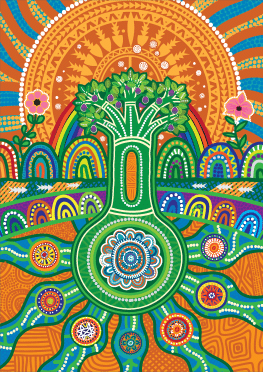
To celebrate 10 years of our union’s Yubbah Action Group, our union commissioned artist Riki Salam (Mualgal, Kuku Yalanji) from We are 27 Creative to to create an artwork.
The artwork shows the growth of a seed of hope into a strong tree, representing the positive impact of union membership, workplace wellbeing and shared values.
The piece brings together both Aboriginal and Torres Strait Islander cultures, highlighting the IEU-QNT’s commitment to reconciliation, inclusion and respect.
Key elements represent important themes:
- The tree symbolises strength, wisdom, knowledge, growth and prosperity.
- The six pathways and circular motifs represent the shared values of the IEU-QNT and reconciliation: partnerships, solidarity, activism, justice, collectivism and inclusivity.
- A seventh circle acknowledges the original Reconciliation Action Plan working group and those who laid the foundations for this work.
- The meeting place at the tree’s base represents the IEU, its members and stakeholders united through collective action.
- Schools and learning places are represented by traditional shelter motifs, reflecting safe and supportive environments for education.
- Fishing nets and fish symbolise working collectively, sharing knowledge and supporting future generations.
- Hills and sandhills reflect life’s challenges, with union support helping members navigate them.
- The rainbow represents hope and our union’s commitment to diversity, equity, inclusion and LGBTIQ+ communities.
- The Cooktown Orchid and Desert Rose represent Queensland and the Northern Territory, symbolising the organisation’s growth across both regions.
- The sun, stars, Southern Cross, Tagai constellation and Dhari (traditional Torres Strait Islander headdress) emphasise guidance, navigation, cultural identity and connection across land, sea and sky.
Artwork story
Earth, seed, smoke. Tracks across plains and desert sands.
Water flows from fresh to salt. Country is celebrated when sun rises.
Tree grows, engravings etched in wood messages sent from place to place.
Stars navigate our way and bring us to new and plentiful lands.
Drums beat, pathways connect us all stretching across land, sea and sky.
Songs are sung in ceremony, we are stronger together, celebrations begin.”
– Artist Riki Salam (Mualgal, Kuku Yalanji), We are 27 Creative.
Message Stick
As part of the launch of our initial Reconciliation Action Plan, a traditional First Nations form of communication, Message Stick, represented an important part of formally recognising Australia’s First Peoples.
The message stick was donated by IEUA-QNT member, Noonuccal woman and Quandamooka Elder, Thersa Nunn, to our union Branch Executive.
The message stick made its way across Queensland and the Northern Territory throughout 2016, visiting schools and workplaces and collecting stories and artefacts before returning to a permanent installation in our union’s Brisbane office.

Closing the Industrial Gap
We are proud to work with our First Nations members and their communities in the spirit of reconciliation. Our work in this context is guided by input from First Nations members who attend our Yarning Circle and Yubbah Action Group meetings.
In 2020, these groups indicated that they would like to see their union take a leading role in advocating for First Language instruction.
Our union and the Queensland Teachers’ Union (QTU) have released landmark industrial guidelines to establish just and fair benchmarks for the employment of First Nations education workers.
The publication of the guidelines is the latest phase in our union’s campaign to Close the Industrial Gap between First Nations and non-First Nations identifying school staff.
The guidelines are the culmination of years of work by First Nations union members and other stakeholders committed to closing the industrial gap experienced by Aboriginal and Torres Strait Islander Language and Culture educators in schools.
They are designed to give employers an understanding of what conditions of employment should be considered as necessary to support employees who are delivering First Nations languages and cultural education and provide value to the work carried out.
Such measures are essential to ensure that education systems recognise broader criteria of ‘success’ that reflect First Nations’ frames of reference rather than expecting First Nations Peoples to conform to norms derived from colonial constructs.
First Languages Australia (FLA), the peak body committed to ensuring the future strength of all Aboriginal and Torres Strait Islander languages, was closely involved in developing the guidelines.
Other stakeholders involved include the United Workers’ Union (UWU), Queensland Department of Education, Brisbane Catholic Education (BCE) and Independent Schools Queensland (ISQ).
Read more about the history and development of the industrial guidelines here.
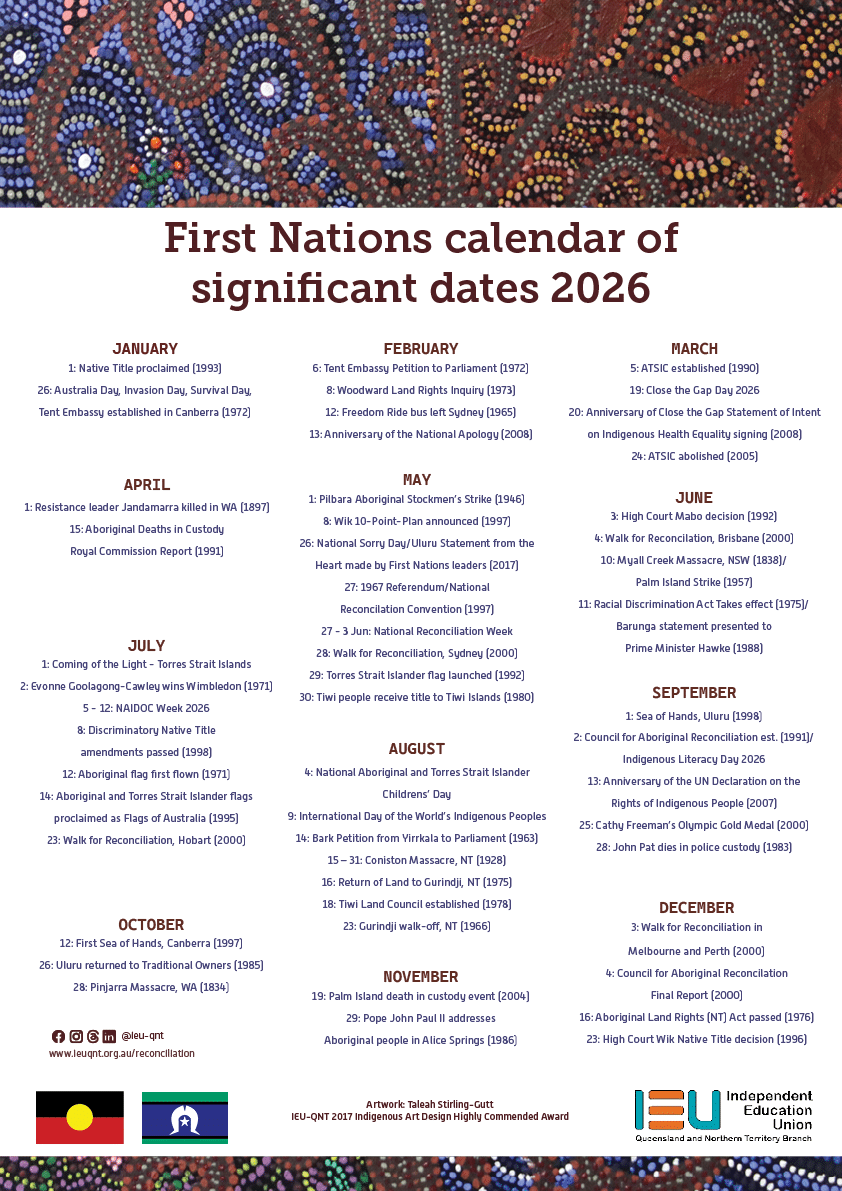
Dates & events significant to First Nations Peoples 2026
Our union’s calendar of dates and events significant to First Nations Peoples has been created as a resource for IEU members to use in classrooms and school staffrooms.
The poster highlights key dates that commemorate and celebrate the histories, cultures, and achievements of Aboriginal and Torres Strait Islander Peoples.
It is designed to prompt discussion, educate school communities, and foster greater awareness, respect, and understanding of First Nations cultures.
IEU-QNT is deeply committed to reconciliation with First Nations Peoples.
We recognise that everyone may be at a different stage in their reconciliation journey, but we all share the responsibility to learn, grow, and contribute to meaningful change.
Our union acknowledges this calendar is not an exhaustive list and that some dates and events may be contested.
We have selected those we believe are particularly relevant and useful for school communities.
All who use this poster are encouraged to continue learning through further research and by listening to the stories, experiences and perspectives of First Nations Peoples in their local communities. Australians, individually and collectively, have a responsibility to continue working towards reconciliation.
If you know of a date or event that should be considered for inclusion in next year’s poster, please reach out to us for further discussion.
IEU members can request an A3 size printed hard copy be supplied by emailing co************@********rg.au
Download your copy here.