

Significant rights at work have been introduced by the Labor federal government over the last three years.
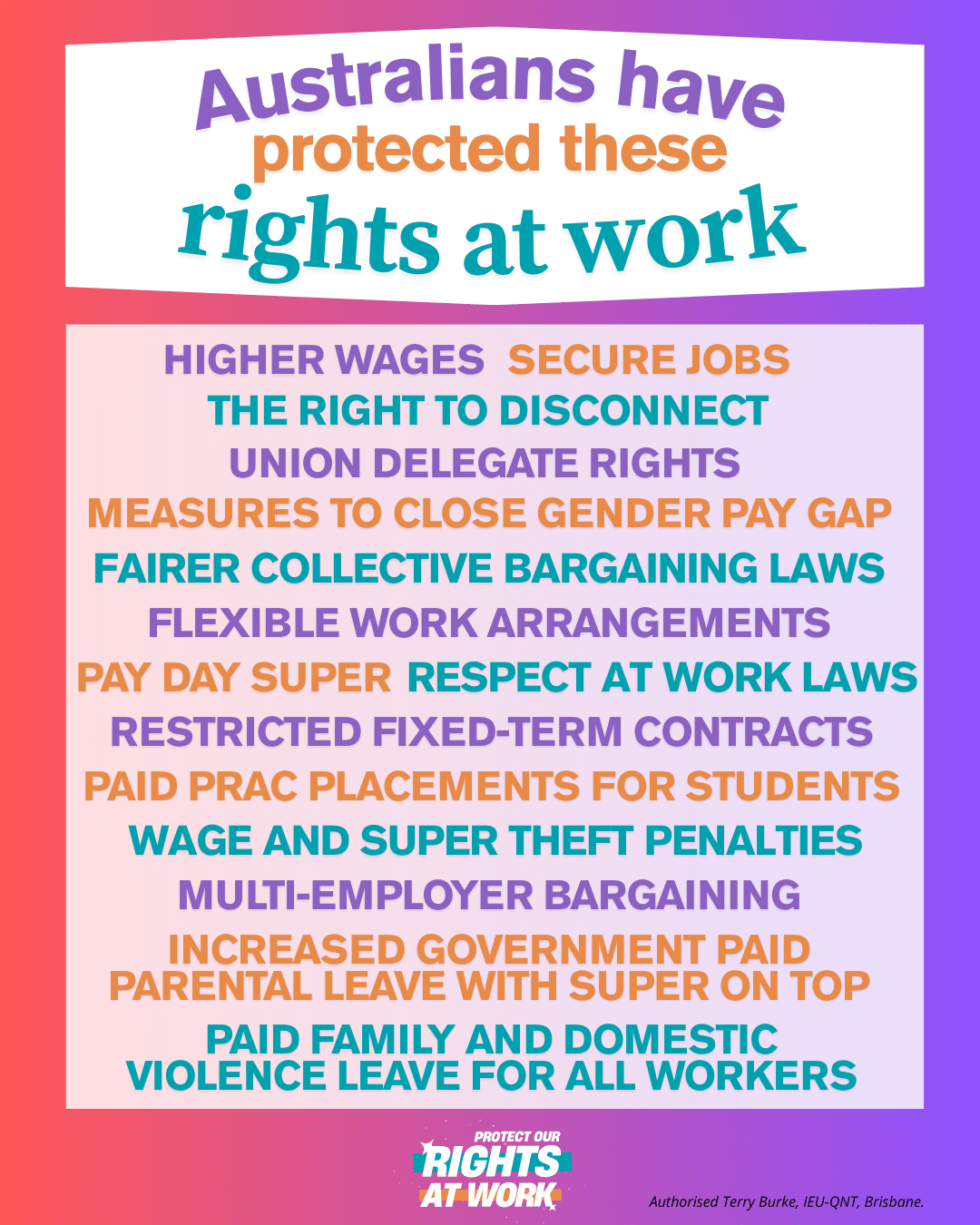
These new rights have made a difference to IEU members’ working lives and have delivered higher wages, more secure jobs, the right to disconnect, industrial rights, more balanced bargaining laws and fairer workplaces for women.
Australians have protected these rights at work, following the federal election result.
The LNP Coalition had publicly pledged to scrap or wind back many of the gains workers have made over the last three years.
The Coalition’s election eve attack on aspiring teachers and women’s superannuation would have seen cuts to paid practicum for teachers and the removal of superannuation on government paid parental leave.
Our union is not affiliated with any political party and does not make donations to political parties, but we have a responsibility to monitor the industrial landscape and advocate for the best outcomes for members.
We believe the best outcome for members is protecting and expanding the rights at work introduced by the current Labor federal government.

- Wages growth has reached a 12-year high under the current federal government, ending a decade of wage stagnation.
- Average pay rises are now 4% per year for union members (and 3% per year for non-union members).
- Cost-of-living pressures would be worse under a Coalition government that promises low wages are a “deliberate design feature” of its policies.
- The gender pay gap is narrowing three times faster under the current government.
- Teaching students would be paid during prac placements under the current federal government while the Coalition will require students to borrow the money and pay it back later on top of their HECS.

- Nine out of every 10 jobs created in Australia over the last 3 years have been secure jobs.
- Since 2022, 230,000 workers have gained a secure job.
- Workers now have the option to convert to a secure job and there are strict limits around the use of fixed-term contracts.
- IEU members have felt the effects of these laws as the era of unfair, rolling fixed-term contracts has come to an end.
- Our union has supported many members – particularly school officer members – to challenge unfair contracts and transition into secure employment.
- These rights are at risk under a prospective Coalition government, which has vowed to abolish secure job reforms.

- Due to new bargaining laws, collective agreement coverage is at a five-year high.
- Collective agreements, where union members negotiate with employers, deliver higher wages and better working conditions than safety-net Award conditions.
- Workers also have additional pathways to secure agreements including multi-employer bargaining.
- In 2023, the IEU – alongside UWU and the AEU – secured the nation’s first Supported Bargaining Agreement (a form of multi-employer bargaining) for early childhood education and care employees across 500 centres.
- This action delivered the landmark 15% pay increase for early childhood education and care workers.

- The right to disconnect allows workers to switch off from workplace contact outside of work hours.
- Teachers, school officers and other employees in our sector now have their weekends, evenings and holidays back.
- Workers no longer need to feel permanently on call to their employers.
- The Coalition has publicly pledged to abolish the right to disconnect if it forms government.

- Rights for union delegates mean union reps/delegates can now represent staff industrially and access training in paid time.
- Workers have fairer access to flexible working arrangements.
- Pay day super requires employers to pay super at the same time as wages.
- Civil penalties are in place for wage theft and superannuation theft.
- In contrast, the Coalition is promising a more Americanised superannuation system and slashing the minimum super rate from 12% to 9%.
- The Coalition will also cut 36,000 frontline public service jobs.
- Employer lobby groups are urging the Coalition to abolish penalty rates for retail workers and finance workers and implement WorkChoices style cuts to other rights.

- The gender pay gap is narrowing three times faster under the current Labor federal government. It now sits at an historic low of 11.5 per cent.
- Government-funded paid parental leave has increased to 26 weeks with superannuation paid on top. The Coalition will scrap this paid super.
- 10 days of “life-saving” paid family and domestic violence (FDV) leave is now available to all workers.
- Employers now have a positive duty to prevent sex-based harassment and discrimination (requiring them to take proactive, preventative action).
MORE TO DO
Workers have made real gains during this term of the Labor federal government; however, there is more work to do.
Reproductive health leave supports all workers with paid leave to manage conditions like menopause, perimenopause or endometriosis and access treatments such as In Vitro Fertilisation (IVF) and vasectomy.
Many IEU members have access to paid reproductive health leave in their collective agreements. This should be available to all Australian workers through the National Employment Standards (NES).
IEU members need a federal government that will address unfair lockout laws that provide employers with a nuclear option during collective bargaining.
IEU members in Queensland Catholic schools have experienced the impacts of these lockout laws firsthand. In 2023, their five-minute strike action and limited work bans was met with the docking of a full days’ pay by their employer.
Laws around protected action must be rebalanced so it is not so difficult for workers to exercise their right to participate in protected industrial action.
We also need a federal government that will monitor collective bargaining laws, including the newly implemented multi-employer bargaining options, to ensure they deliver the results for workers that they promised.
While there is more to do, our union believes the current Labor federal government has implemented a positive agenda for workers – IEU members’ working rights are at risk if there is a change of government.